The World is an amazing place .... go and be in it


Thursday, 3 January 2013

Facets of the Sapphire

We pick up the Princes Highway at Bairnsdale and head north to the Sapphire Coast and it’s not long before we stumble upon her gems.   Although we left Bairnsdale early, I did insist on checking out the towns historical buildings and was delighted to find a lovely old railway station (and it wasn’t orange!), a magnificent old court house that looked more like a castle, a beautiful grand dame of a hotel and the cutest little rotunda.....being on stilts had me pondering the great flood concept though.... along with the 'interesting' hobby shop.

We hadn’t had our first cup of coffee for the day and so ambled into the small waterfront village of Metung. Nestled on the banks of Lake King, this tiny village is an absolute diamond – vibrant in every way yet so kick-arse chilled out lazy!  It has gone to the top of my ‘must return’ list, highlighted in bright red with gold stars – We love it.... 


So divinely quaint and charming with its wrap around boardwalk over the bay and river, grey and white timber boat-house style abodes and  black swans paddling around boats – big and small bobbing gently in the lake.  We wander around the park like streets of the village and take in the nautical sculptures hidden amongst the public gardens then sit on the piers and watch the lines being cast in (and pulled out with catch) and fantasise about coming here for a week of doing absolutely nothing except drink great coffee (which we find at the Galley Cafe) and perhaps lazing  on a yacht on glistening turquoise waters.
 
This village’s status of precious jewel was confirmed as far back as 1885 when it was called the “gem of Lakeland” – at that time there were only 41 inhabitants in the village.  I think many an aussie bloke would think the locals of Metung have their priorities in the right place, especially in 1945 when the local pub was burning down.  The fire-brigade captain – brave man according to Big M – was declared a hero when he rescued the beer from the burning building and carried it to the village green, where the keg was tapped under the Morton Bay Fig and business resumed as usual. His bust (carved in timber) takes pride of place on the bar of the re-built pub.
As in the past where I fixate on a certain architectural structure....railway station, lighthouse etc, I suddenly developed a fascination for bridges. Bizarre I know but for some reason on the Princes Highway part of our trip it’s became bridges, and so upon leaving Metung  I insisted we find the Swan Reach Bridge which according to the brochures was very ‘photogenic’.  Up and down the small township of Swan Reach we drove, under the highway bridge (not at all photogenic!) and back towards Bairnsdale....much to Big M’s disapproval... but to no avail, no camera-friendly bridge appeared.  

The deep blue of Lakes Entrance was the next enticing gem of the Princes and a huge favourite with boaties of all types.   The bar was like a highway with the amount of traffic coming and going – the wakes making spectacular white patterns across the blue. From our vantage point at Jemmies Lookout we could just see the oil well platforms out in the bass strait, including the flame of the “Kingfisher” platform, some 34 nautical miles out to sea.  Then it was a stroll of the moorings to drool over the magnificent yachts, ogle at rugged fishing fleets and ponder the enormous aluminium catamaran that looked like a deep sea mapping vessel. Along the foreshore sat fabulous chain-saw carved sculptures of WWI heroes; the war nurse, the stretcher-bearer and the ultimate hero of mateship, Simpson with his donkey.  Sculptured by John Brady in 1990 into the butts of the Cyprus trees (originally planted in 1924) that grew along the foreshore, they are a magnificent example of ‘bush’ artistry.
At  Nowa Nowa it wasn’t the galleries of wood sculpture that took my fancy but the Stony Creek trestle bridge built in 1914 which became my next ‘must see’.  Set in bushland along a dusty track, this enormous bridge (a former railway bridge) is now part of the walk/biking track of the East Gippsland Rail Trail and at 19meters high and 276meters long, is the largest wooden trestle bridge in the southern hemisphere. 

Further along the Princes crown, we turned off and wound our way past dairy farms and countless grey nomads setting camp on cosy corners of a riverbank to the gorgeous little town of Marlo and to where the mighty Snowy River meets the Bass Strait.  The town is a delight for families and as we sat on the sandy banks at the Snowy’s mouth, eating some of the best fish and chips ever!!!!, we watch children build sandcastles,  net for crabs and other small marine life, and yell with delight as they were towed on rubber tubes behind boats. 

For me it felt very strange to be sitting on the banks of the Snowy looking at the ocean, for this rivers very name conjures images of mountains; like the Man from Snowy River riding down a massive slope, or the enormous turbines built in the 50’s to harness the Snowy’s waters into electricity, even  of trout fishers casting and drawing back their flys in clear rippling ankle/knee deep waters.   And although I know perfectly well that rivers head to the sea, I never imagined or thought of the Snowy making its way to coast.  As in the many times I had visited the Snowy in the mountains and found it exquisitely beautiful, here too I also found its final flush so very picturesque.


My next bridge obsession came near Orbost where an old railway bridge over river flats extended for a good length.  Although not as intricate or large as Stoney Creek, this bridge still fascinated me in that for the length and narrowness of it, it had withstood the pressures and weights of the many trains that passed over it.

Although it was late afternoon and we still had ninety kilometres to go till we arrived at our next stop for the night, Eden, we decided to turn off the highway and visit Mallacoota, the last (or first) official township of eastern Victoria. What a darling town!  Hidden behind forests of palms, ferns and eucalypt trees, with the cutest shops, ice-cream parlours and cafes, and with quaint seaside bungalow homes,  it was as if the whole town had become a caravan park with tents perched on footpath verges, in parks and along walkways;  vans and countless boat trailers taking up every available spot around the main street and foreshore and endless rows of campers.
 
We made our way down to the foreshore and were amazed by the numerous birds settling in for the night on the small islands in the inlet – pelicans, gulls, shearwaters and many more of which I have no idea what their species is.  I would have loved to have gone to Gabo Island just off Mallacoota to see the pink lighthouse (built in 1862) but had to go with a more time viable option (plus  keep Big M happy) with the WWII bunkers.  Another dusty dirt road through forest and next door to the shooting range, brought us the bunkers with a sign stating opening hours were “Tuesday morning – 9am to 11.30am”...hmmm gotta be quick! 
One of the interesting sights of Mallacoota was the many signs outside homes and along the road demanding the saving of Bastion Point.  This pricked my interest to no end (being an activist from way back) and a little research had me learning that the East Gippsland Shire Council proposal to ‘improve’ the small villages  current boat ramp (that’s in disrepair)  comes with a massive breakwater (110metres long) to be built over the reef and into the surf break (the surfers are well and truly up in arms about it – they’ve put it on their Endangered Wave list!) and includes a road (to be built on the beach), carpark along the cliff top and the removal of 3500cu of rocky reef....not to mention the ongoing dredging of sand.  This is all for a town that has less than 900 permanent residents and is classed as one of the most isolated towns in Victoria.  Plus the area of Bastion Point sits in Croajingolong National Park. I shake my head at the ‘powers that be’ and wish the residents the very best of luck in stoping this monstrosity.
This southern part of the Sapphire Coast is indeed breathtakingly beautiful; from the azure waters, gold sandy beaches to the heathlands and pockets of rainforests filled abundant birdlife – on the way into Mallacoota the bell birds and pilot bird calls were almost deafening – yet it was very sad to see the destruction done to the forests along the side of the highway.  Large tracks of eucalypt stands had been razored, many of the ‘smaller’ trees just left trashed on the ground; precious natural resources wasted.  Although I understand this is plantation forest and some felling should be left to become habitat for wildlife, this amount of waste is actually a fire hazard, not to mention an absolute eyesore. 
As we pulled into Eden, I dismount from my high horse and look down at Twofold Bay.  Another gem awaits to be discovered.

Wednesday, 2 January 2013

On a wing and a prayer

The smell of eucalyptus assaults the senses, it’s almost overpowering and the air crackles with heat.  Dust covers everything, rising into the air drifting into the bush, joining the haze that sears across the mountains.  Inside the car I’m hyperventilating, failing to control a massive panic attack that has descended upon me, whilst we are winding our way ever so slowly up a steep dirt section of the Omeo Highway in the Victorian High country. 


It’s almost one hundred kilometres of this type of road and we are unable to drive a speed of more than forty kmh.  I feel trapped and very, very afraid. It’s so dry and sweltering hot outside, I’m terrified the surrounding forest will catch fire and there’s no way out.  Only two days ago, on the 31st as we were driving back to Wodonga I’d made a suggestion we stop off at Violet Town  only to hear on the radio just ten minutes later that it and the Boho area were facing a large grass fire. Then on New Year’s Day, there was a bushfire on the outskirts of Albury.  It was fire season in Victoria.  It was also heat wave conditions in Victoria.  All day on the radio, the warning to ‘know your bushfire response’ is playing, and here we are driving in one of the most heavily wooded areas of the state.  I was in hysterics.
We had decided to skip the lower south-east coastal route and instead pick up the coast road in East Gippsland, starting at Bairnsdale.  After a quick look at the maps, Big M thought the quickest route to Bairnsdale would be via Mitta Mitta instead of the Mount Beauty road...how wrong were we! 
Big M does his best to drive and try and keep me calm.  He points out beautiful bright red parrots as they fly past and comments on the wildflowers along the verge but to no avail. All I can think is “this is the stupidest idea and we’re going to die!’ The drive is excruciatingly slow and it’s not until we’ve finally reached the peak of the mountain we’ve been climbing and start going down again that I stop feeling faint.  

All along I keep praying for God to take me out of here and I find it a little bizarre to see sign posts telling us we’re driving across the “Devils Backbone” and crossing creeks called Haunted Creek and St Patrick’s Creek...perhaps a touch of the above..... 

At Glen Willis we come across an eerie scene of a cemetery filled with white unmarked crosses. A sign at the far end of the cemetery tells us it’s the last resting place of some ninety-seven people who died between the years of 1894 and 1920 – forty of the graves are infants.  These were people who lived and made up the community of Glen Willis and Sunnyside – Miners, wives and their children.  I look around, there is nothing here. These people working this area were isolated; their lives would have been hard, for the wives and children, almost suppressive.  It’s heartbreaking to read the names of so many babies and children. Despite it’s sadness, it feels like a peaceful place.
Omeo is a breath of fresh air and I suck it in hungrily.   I’m so relieved to arrive, some six hours after we first left Wodonga, and I take myself off on a walking tour of the village enjoying the heritage and prettiness of it all until I reach the top of the street and read how the town was practically wiped from the map by the 1939 Black Friday bushfires.   As I look down the street at the buildings, especially the Golden Age Motel which  over it’s time has burnt down some six times, I can’t help but admire the resilience and strength of our past pioneers.
Our next stop was the quaint town of Bruthen, which owes its claim to fame to being the town where Flt Lt Ralph Oborn in 1958 became the first pilot in Australia to eject safely from an aeroplane – just as his RAAF Avon-Sabre jet crashed into the outskirts of the town – just avoiding the built up area. It was also the first time Oborn had ever used a parachute. Now that’s definitely having a guardian angel on your side.  I do wonder however, if the local publican of the Bruthen Hotel is trying to get his own claim to fame – if his sign is anything to go by.

Bairnsdale was the end of our wing and prayer drive and what better way to end it then taking time to give thanks for a safe trip at the spectacular catholic church of St Mary’s.  Although quite an imposing structure on the outside,  it’s the interior that holds your attention.  Beautiful murals and ceiling paintings adorn the entire dome and walls. Stunning  in colour and vibrancy.  The tourist brochures claim they are reminiscent of the Sistine Chapel and although I myself wouldn’t go that far as to say that, I must say they are incredible and quite mesmerising.  Painted by an Italian artist Francesco Floreani in the 1930 during the Great Depression, they would have lifted the spirits of the community.  They certainly lifted mine.


post script – 2 days after writing this Victoria reaches heatwave temperatures of over 40degrees and grass and bush fires spring up; including near  the small town of Ensay which we passed through (near Omeo)

Tuesday, 1 January 2013

From ‘The White Lady’ to a black demon...

I’m hoping to redeem myself a little from ‘sight ticker’ to an ‘in the moment being’ after the marathon race through the Great Ocean Road.  Arriving to the gorgeous seaside town of Anglesea as twilight folded we were eager to start early in the morning to explore it. Unfortunately the drive had exhausted us and along with enjoying an evening with friends, our early morning became a little later than hoped, however our friends were wonderful tour guides and treated us to the 'real' Anglesea and Aireys Inlet.   What a divine pair of villages.

Anglesea is a small close-knit community with an enormous encompassing spirit and nowhere is this more evident than in a community garden that would WOW the beard off Costa from Gardening Australia! 

The Anglesea Community Garden was abundant with succulent produce – plots of organically grown vegetables and fruit trees companioned planted with beautiful flowering plants to encourage the bees and distract to pest. A pizza oven sat in the middle of garden, bringing the community together for social gatherings as they enjoyed the fruits of their labour.  The garden was set in the public community precinct and  is surrounded by native garden beds planted by the local AngAir landcare group with beautiful mosaic artwork carried out by local artists adorning the pathways and public buildings.
 
Our next ‘garden’ to visit was to the beautiful heritage listed heathlands of Anglesea.  The area of Anglesea and its surroundings hold one quarter of Victoria’s plant species with over a hundred varieties of orchids alone growing in the surrounding environment.  We’re told we must come back in the spring, as the area is a sea of colour when the wildflowers bloom and flourish.  Although it isn’t spring now, we are still surrounded by spectacular colour.   
As we head further into the heath lands, Big M and I are shocked to see straight across from the ‘protected lands’ is a massive ugly open cut coal mine.  A huge dirty black hole scaring the magnificent bushlands that surround it.  The coal from this mine feeds a power station for an aluminium smelter.  And it sits less than eight hundred metres as the crow flies from the town!  I’m flabbergasted!... 


I know the smelter is important to the area, supplies jobs and industry but to have the mine so close to such a pristine wilderness as the National Heritage Heathlands, not to mention, next door to a beautiful seaside village. Surely there is a better way to fuel it’s power station?  A more environmentally alternative power source.
Although we were getting the ‘locals inside tour’ we couldn’t not visit the beautiful beaches and headlands of Anglesea. Spectacular!  We were amazed to see the evidence of an enormous landslip at the southern end of the village and amused to learn how it ‘disrupted’ one chaps plans. 
In 1903 this chap rowed out to the shipwrecked vessel, the ‘Inverlochy’ and ‘borrowed’ a case of whisky and buried it for later. The very next morning at 4am the landslip happen and ‘buried’ it further.  
Just around the corner from Anglesea is Aireys Inlet and upon visiting it I felt as if popular culture was blending with reality.  Our first stop was to the newly open 60’s Roadhouse, where Big M was in his element.  The fabulous American style ‘milkbar’ is filled with garage/automobile memorabilia with a showroom any racing enthusiast would drool over. 


About eight vintage racecars from various eras sit behind glass with a front row seat in the bar.  Not only was it that they were vintage cars that excited Big M, but also the fact that he had seen a number of them at various time in actual racing action.  From the milkbar, I feel like I've stepped into 'art imitating life' when I'm introduced to the owner of the local Bookshop and after hearing how she had started the local writers festival (now in its third year) I could have sworn it was the plot and quite possibly the inspiration for the June Loves novel – The Shelly Beach Writers Group..... I wonder.....
The final must see was the magnificent “White Lady”, the Split Point Lighthouse.  A stunning white tower with red cap and the star of the ABC TV show – Round the Twist.  She stands so majestically surrounded by a mass of green shrubbery that must look so amazingly colourful in the spring.  Below,  waves crash against the cliffs and jutting from the ocean sits one loan limestone formation, perhaps an apostle cast out of the group – Judas? 


As we leave (and inadvertently add another rubbish tip to our ‘tip-rat tour’) we vow to return and plunge ourselves once more into this wild south-west coast line of Victoria that is indeed a breathtaking icon.

Monday, 31 December 2012

Great, Great, Great point nine recurring.....

May the travel fairy who gives us our wings of freedom forgive me and may the cupid that shoots his wander lust arrows into our adventure butts not hit me over the head with his bow, for what I have to confess is sacrilege.
We drove the Great Ocean Road in one day.  
The beauty about having no set plans is that one can be completely flexible.  However, that plan to not plan sometimes can go completely haywire and that is how our unplanned meander became a marathon.
We came unstuck when unable to find any accommodation at Port Campbell (our planned next stop after Port Fairy) we were to spend the night in Warrnambool and after searching high and low for a room we settled for a really low room.  There was another offer on the table, the honeymoon suite at another establishment for a few hundred dollars, and as much as it’d be nice to feel like we’re on our honeymoon, after all the biking, hiking and driving, we were way too exhausted to appreciate the costs.  

In hindsight, it would have been money well spent.  Instead, we were to share the neighbouring walls with a chap who thought yelling abuse for hours on the phone to his girlfriend to get him cigarettes would endear him further. When she (along with a friend) finally did turn up, he proceeded to assault her in the car park before taking it to the room where a screaming match over cigarettes led to threats of being stabbed with scissors.  We made numerous calls, begging, pleading and on my part crying to the managers of the motel to do something about this hideously traumatic  event, upon which the managers, too scared themselves to confront the ‘guest’ made numerous phone calls to the police begging and pleading for them to come.  Big M wanted to go and confront the man but I begged him to stay inside terrified he’d be stabbed or shot...who knows these day what weapons people are carrying.  Two and half hours later, at 1am the police finally arrived, took the woman (and her friend) away and left the man to his own devices in the room....next to us, much to my absolute horror!  Not a wink of sleep eventuated, as I was too terrified he’d find someone or something else to vent his lack of cigarette anger on. 
After such a terrifying night, we couldn’t get away from Warrnambool quick enough and as such was on the Great Ocean Road nice and early.  So eager to get away in fact that Big M forgot to check how much fuel we had and it wasn’t until we were at our first “Oh my god, this is so amazing sight” that he looked down and noticed we were running on empty...with still about 20kms to go before we arrived a Port Campbell. But we weren’t worried, for the Great Ocean Road really is everything everyone has ever said and more!...
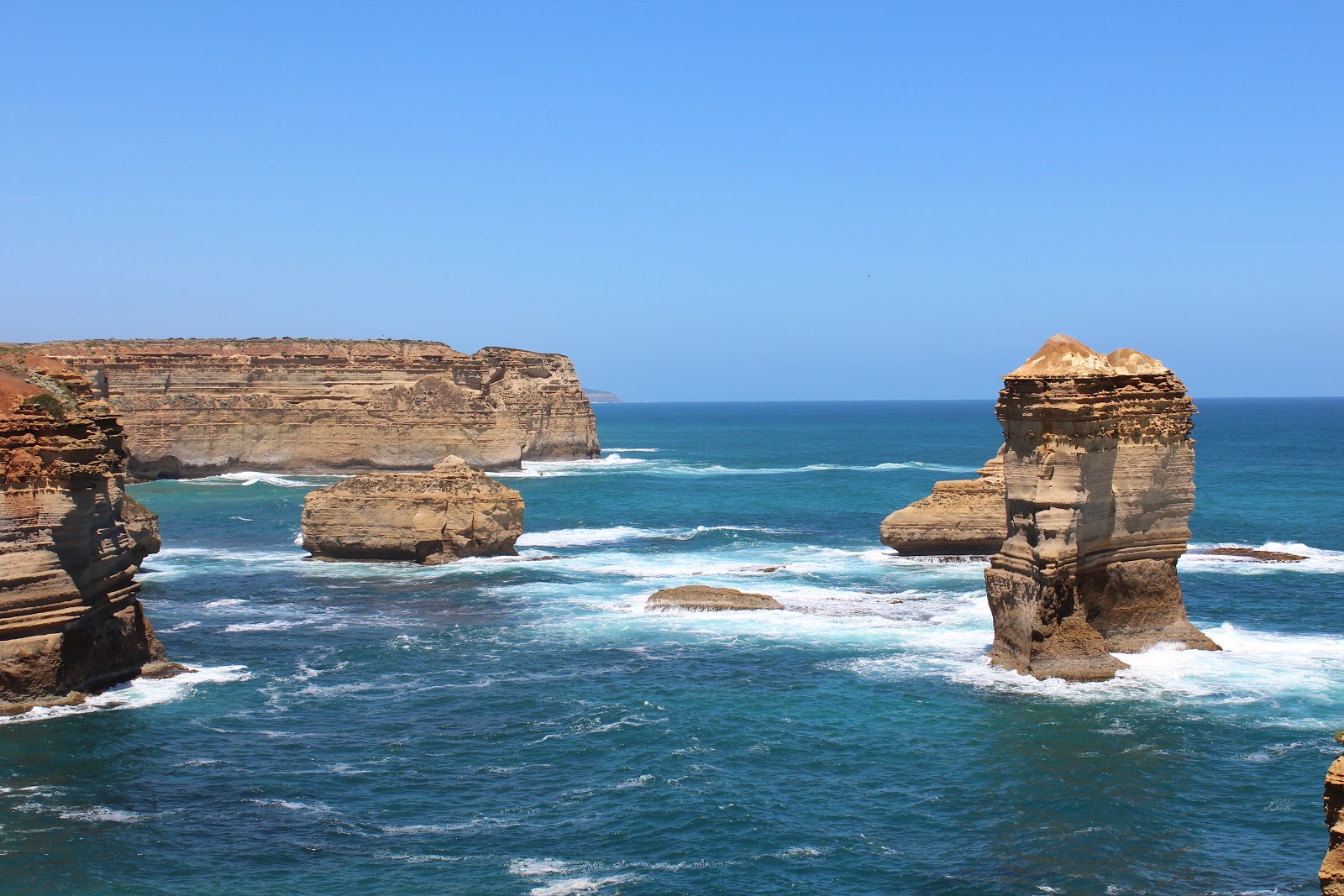
From the very first rock formation jutting majestically out the sea, we were enthralled.  Spectacular limestone cliffs, craggy and sculptured from millions of years of being moulded by the winds and waves line the coastline, starting at the Bay of Islands and continuing down to Otway. They were once known as the ‘Sow and Piglets’ but thought it more dignified to rename them ‘The Apostles’, which became the ‘Twelve Apostles’ – tho there was never twelve but nine rock formations in the group.   Every single one of these formations holds us spellbound, it takes us four hours to drive from Bay of Islands at Peterborough to Port Campbell, and we still hadn’t arrived at the Twelve Apostles.
At Port Campbell we enjoy our Christmas present we received from Bud and the Gorgeous Gal – a helicopter ride over the Twelve Apostles.  Despite my fear of the tiny flimsy piece of aluminium held up by two chop-sticks....I’m a shocking flyer.... I lost myself in the beauty that unfolded below us and Big M and I couldn’t wipe the smiles off our faces as we flew over the bluest of ocean with these magnificent cream and coral coloured structures.  All too soon the flight was over and I was wishing we were still up there, bouncing and buzzing above natures artwork.  After filling up at Port Campbell, we drove to the viewing site of the Twelve Apostles and jostled with the thousands of other enthralled tourists who were also held mesmerised.  Despite the crowds, seeing the 65metre  rock formations in real life is an awe-inspiring experience. 
 
It was 3.30pm by time we tore ourselves away from the cliff edges and we still had to get to Anglesea before nightfall.  You see, we had to change our ‘plans’ as we were going to spend new year’s eve with Bud and Gorgeous Gal, and we had also organised to stay with friends at Anglesea, tonight being the only available night, hence the reason why we were being so disrespectful to this spectacular road-trip route.   Despite the lateness, I was determined to see Cape Otway lighthouse and so we hightailed it along the road and made it to the lighthouse with fifteen minutes to spare to gain access.
  
 
Cape Otway is Australia’s most significant lighthouse, the first sight of land for those who came to the Antipodes via the Great Circle Route from 1849onwards.  My own ancestors viewed this lighthouse as they sailed into Port Phillip Bay, it would guide the ships through the ‘eye of the needle’  and many a settler would give a prayer of thanks upon sighting it.  It’s not a very big lighthouse but still quite spectacular.   A pure white tower with a bright red rail at its top.  I climbed to the top and viewed the beautiful coastline – seeing for kilometres either side.  Below in the grounds sat the beautiful lighthouse keepers cottages and associate buildings, all very white and very pretty.  Upon leaving the Cape, we were to find the road lined with trees full of koalas.  We’ve never seen so many koalas in one area, not even in a animal park!  Each tree had at least two, many had three or four koalas. People were just stopping their cars on the road, getting out running back and forward photographing the koalas. We joined them.
 
We whisked through the pretty little towns of  Apollo Bay, Lorne and past the Diggers memorial at Fairhaven, in honour of the 3000 returned soldiers from WWI who built the Great Ocean Road (my own great-grandfather being one of them....I am so hanging my head in shame for not stopping) and almost cried with despair as we drove straight through what is said to be the most spectacular part of the road - where the diggers had hand-chipped and dug the road out of sheer rock - the switchbacks and bridges of Eastern View.
And so  I ask, may the travel fairy forgive me and grant me again the chance to return to the Great Ocean Road.  It’s on my ‘one day I going back list...’

Saturday, 29 December 2012

Back to the beginning...

In 1834 a Ladybird floated into a beautiful bay and birthed a Colony that would become the richest state in early Australia – Victoria. This tiny town, Portland, became the first permanent settlement of Victoria and is to be our first port of call as we make our way along one of the greatest road trip routes of the world – the Great Ocean Road.  The former domain of sealers and whalers and the graveyard of many a ship, the rugged coastline is buffered by fierce winds that can blow in at any time from the Southern Ocean and the morning we wake, we experience firsthand the turn of the weather and coldness the great southern can bring. 
 
Despite the wet, windy, chilly...no make that icy, weather (in December?!), we’re enthralled by our surrounds.  Living history encases us from the moment we open our eyes in our room in the  gorgeous Gordon Hotel - the oldest  continuous license in Victoria (1841). As we breakfast on the balcony, we don’t know where to look first – at the bay filled with small sail boats, over to shipping wharf where enormous cargo ships loom or  soak in the views of  blue stone  public buildings which are still in government use since built;, such as Customs House (1849), or the stunningly beautiful Mac’s Hotel (1856) and the majestic former post office (1883).  However, this time it’s not buildings I want to explore, it’s the natural wonders of the ‘Discovery Coast’ and we leave early to trek through the petrified forest.
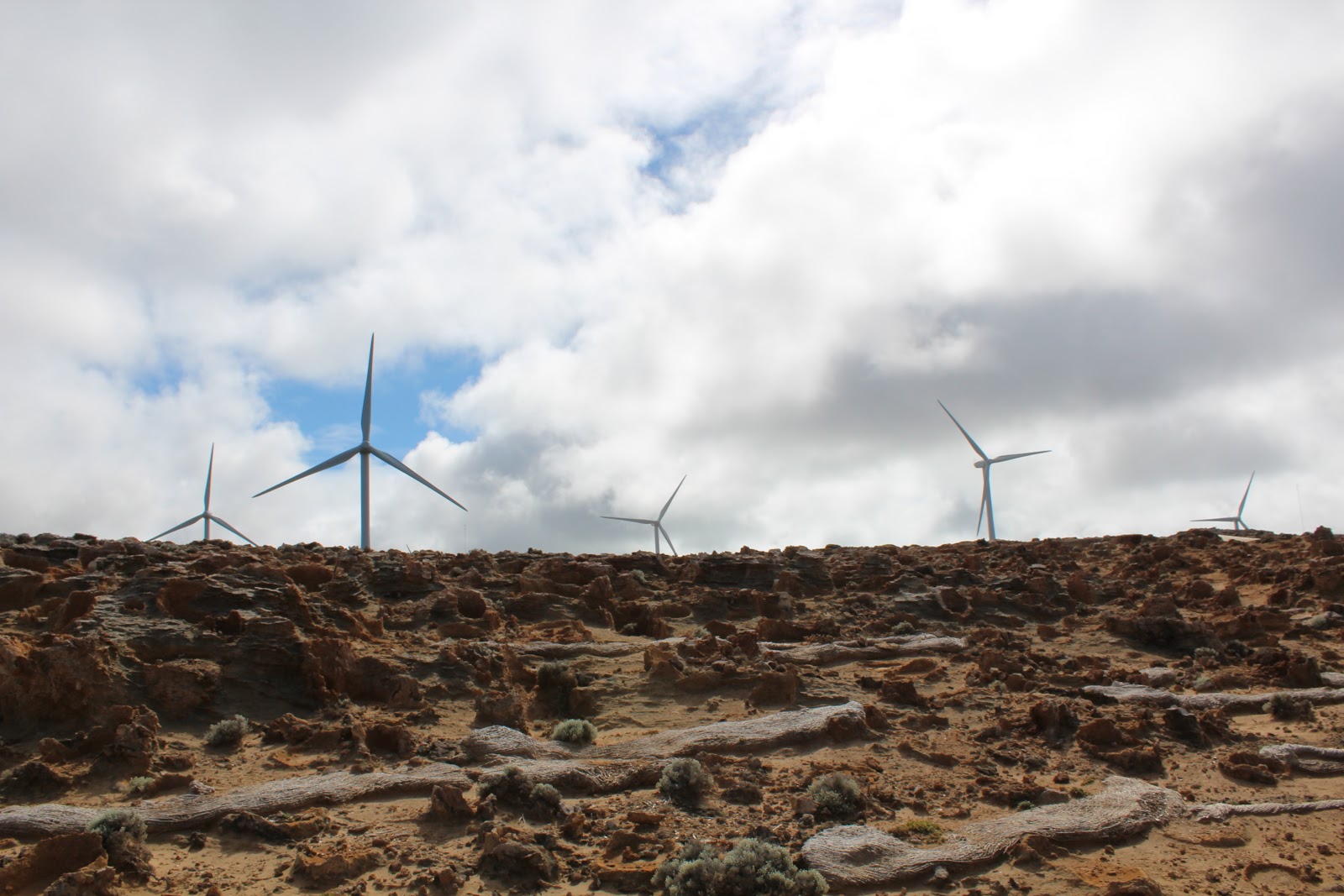
Green pastureland with windswept trees leads to hills lined with wind turbines, then the green stops abruptly and a moon like landscape appears. Perfectly formed circles with jagged edges jut upwards. Cement hard, yet inside sits soft sand almost dust like, the limestone rings scatter across the land in front of us, their brownness smashes against the deep blue of the ocean and even with the grey skies, the colours are sharp and vibrant.  No one knows how this amazing scene has formed; some experts say it’s a forest of Moonah trees smothered by sand thousands of years ago. Other experts say it’s a natural erosion of stone by earths minerals. Either way, up close it looks to me like beautiful ancient organ pipes playing nature’s tune of the wind with the stand of majestic white windmills in the background mixing the ‘synthesized’ tones.
 
To the other side the ‘forest’ is the remains of a lava flow; rippling black rock ‘spills’ midair into the ocean  and creates a spectacular cliff face.  The ocean slams against its edge and sprays across the rock beds below.  Just off this point the watery grave of the Isabella. Around the ‘corner’ at Cape Bridgewater is the start of the ‘Shipwreck Coast’ where some fifty plus colonial vessels met their fate in the great southern ocean.
The lighthouse at Cape Bridgewater begins my ‘avenue of lighthouses’  fascination (although Big M makes it very clear that we’re not going to start at the very beginning – Cape Nelson – I see a new list starting).  The lighthouse is adorable, not as spectacular as ‘our’ Byron Bay beauty, but still very picturesque...despite our scaffolding tour of it.  I love it’s bright red cap.  I will find that red is the colour of lighthouses here....  We are also in for a bit of a treat when we notice the sky is full of yellow capped Gannets flying above us. Beautiful white birds with the most gorgeous blue rimmed eyes and black tipped wings.
Time was getting away so we made headway for Port Fairy, bypassing the seal colony and further exploration of Portland (but not before a quick stop at the cutest little lighthouse at Portland – red cap and red door...so sweet) and decided to continue our nature theme of discovery, unpacking the bike and riding across the foot bridge to Griffiths Island.  The island is a protected reserve rookery for Muttonbirds and we were fascinated riding through the dunes to see the burrows covering the island. 
As the track became narrower and rockier I began to wonder (aloud)  if we were even allowed to be riding bicycles on the island, then became convinced that we were definitely not allowed and knowing our luck, get fined for bringing a ‘vehicle’ onto the island....much to the annoyance of Big M... when we found ourselves at a huge rock bed on the beach.  There was no way one could ride a bike here and for almost a kilometre, I pushed and carried my bike across the rocks and tussocks of the island. 
Finally, we arrived at the Lighthouse... another picture of prettiness with red cap and red door and this time, red window inlets... and to my intense relief the gateway was a sea of bikes.  The island was originally a whaling station established back in 1835, now it was popular for whale watchers who came to see the beautiful Southern Right Whales.  Back in the township we watched the fishing fleet coming up the Moyne River and ogled one boat unloads crate after crate of enormous orange-shell crayfish.   
 
The main streets had a festive ambiance with a band playing in the central park and we peddled along soaking up the history, gasping at the gorgeous buildings from yesteryear. This town has over 50 heritage listed buildings, some on a grand scale, others the quaintest cottages of timber and stone.  A restored coach; quite possibly a Cobb & Co coach, drawn by two horses clip-clopped down the street capping off the feeling of being in a colonial ‘fairy tale’.   Little do we know that our dream day is about to have a nightmare evening.